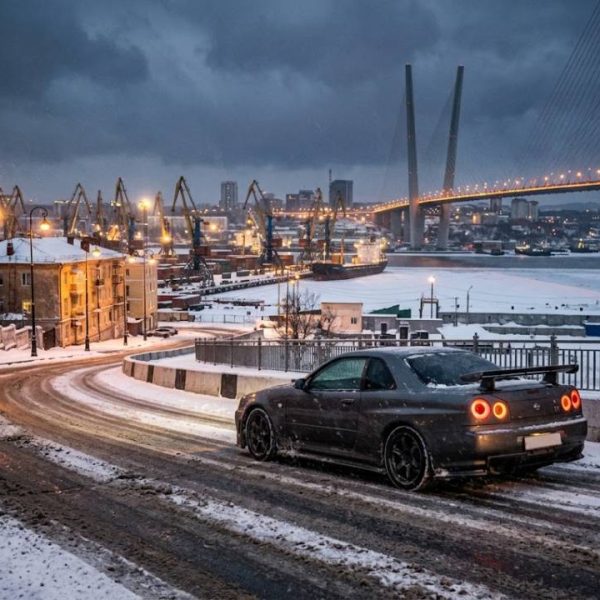
Stand on a hill above Vladivostok and watch the traffic below, and something looks odd to a European eye. A huge share of the cars have the steering wheel on the right. Sitting just across the Sea of Japan, Russia's Pacific port city has spent decades absorbing used Japanese cars, and its car culture grew up around them.
For Skyline fans, that history matters. The region became one of the most unexpected places on earth to spot JDM legends, including the R34. Here is how that happened, and what it means if you are hunting for a car or parts with a Russian connection.
A port city built on Japanese cars
After the Soviet Union collapsed in 1991, Russians in the Far East suddenly had access to Japan's enormous used car market. Japanese owners faced strict and expensive inspections as cars aged, so perfectly good vehicles were sold cheaply for export. Ships loaded with them sailed straight to Vladivostok.
The local economy adapted fast. Dealers, mechanics, parts traders and car markets sprang up, and right-hand-drive cars became the norm across Siberia and the Far East. The phenomenon is a textbook case of a grey import market growing far beyond anything its regulators expected.
Where the R34 fits in
Most cars shipped to Russia were everyday sedans, vans and 4x4s. Performance models were rarer, but the Skyline name always had a following. GT-T and GT-R versions of the R34 arrived through the same channels, and local tuners learned to work on the RB25 and RB26 engines.
For collectors today, that creates an unusual situation: R34s with Russian history exist, and some of them are now offered to buyers abroad.
Changing rules, changing flows
Moscow has tried many times to slow the flow of used Japanese imports, raising duties and introducing fees that hit older and more powerful cars hardest. Each change reshaped the market. Some cars stayed in the region for decades, others were moved on to Central Asia or Europe.
As R34 values climbed worldwide, sellers in Russia and neighbouring countries began listing their cars for international buyers. That is where language becomes a practical hurdle.
Reading Russian listings
Listings on Russian platforms are packed with useful detail: body codes, engine numbers, modification lists and service records. They are also full of slang and abbreviations. Machine translation handles the basics, but misses nuance around damage history, legal status and customs clearance.
If you are serious about a car, professional russian to english translation of the key documents is worth every penny. That includes the vehicle passport, customs declarations, sale contracts and any inspection or repair reports.
Documents you will meet
- The vehicle passport, which records ownership, engine and chassis numbers
- Customs clearance documents showing the car was legally imported
- Sale and purchase agreements
- Export paperwork when the car leaves the country
Chassis numbers must match across every document, or you may never be able to register the car at home. Careful translation makes mismatches visible before money changes hands.
Cross-border deals of this kind generate a paper trail in two or three languages, and dedicated document translation services keep every page of it readable to the buyer. They translate vehicle passports, customs clearance forms and sale agreements with each number, date and stamp carried over exactly. That matters because registration authorities will not accept a chassis number that differs by a single digit between the original and the translation. Getting the documents translated professionally costs far less than unwinding a deal built on a misunderstood record.
Selling or sourcing parts
The Russian-speaking tuning scene is large and active. Owners trade rare RB26 parts, body panels and interior pieces across borders. Communicating clearly with sellers sometimes means working the other way round too, with translation from english to russian for your enquiries, invoices and shipping instructions.
The same market reaches into Ukraine, where many JDM fans and workshops operate. A clear ukrainian english translation of a workshop invoice or parts certificate helps when your insurer or import authority asks for proof.
European buyers and paperwork
Once a car reaches the EU, the paperwork chain continues. A buyer in Lyon or Brussels may need registration history and inspection results explained to local authorities. French to english translation services are often needed when French previous-owner documents join the Russian file, so that one importer or insurer can read the complete history.
Red flags when buying
- Sellers unwilling to share clear photos of chassis and engine stamps
- Documents with handwritten corrections or missing stamps
- Prices far below market value
- Pressure to pay quickly through unusual methods
- Unclear customs status
Take your time, ask for scans of everything and get independent translations rather than trusting a summary from the seller.
The romance and the reality
There is something irresistible about an R34 that spent years dodging potholes in Vladivostok winters before heading west. Every scratch has a story. But romance does not register a car. The best Russian-history R34s come with a complete, verifiable paper trail, and understanding that trail in your own language is the only way to be sure.
Final thoughts
The Russian Far East played a surprising role in spreading Japanese car culture across a continent. For today's Skyline hunters it offers opportunities, alongside real risks. Do the homework, translate the documents properly and treat every claim with healthy scepticism. Your future self, standing proudly next to a legal and well-documented R34, will thank you.